Preparing for Possibilities: Four Considerations for Taking an Extended Leave at Work

Major life events can turn your world upside down. There are all kinds of logistics and planning involved—especially at work. When preparing for life’s big moments, you’ll need to factor in your job and the impact of an extended leave or or employee leave. Whether it’s a new baby, a medical situation, caring for a loved one, or any other event requiring time away from work, planning can make the transition smoother for everyone involved. 

Why Extended Leave and Employee Leave Deserve More Attention Than They Get

These situations feel personal, and they are. But they also come with a lot of responsibility on your end as the employer.

Extended leave usually means several weeks or more away from work. It can come out of nowhere, and if you are not prepared, it can ripple through your team fast. From lost productivity to legal risks, the stakes are high.

If you fail to accommodate someone’s legitimate need for leave, you risk losing a valued employee or ending up in a compliance mess. But when you get it right, you earn loyalty, boost morale, and protect your company.

And the legal part? It’s not optional. Under the Family and Medical Leave Act (FMLA), eligible employees are entitled to up to 12 weeks of unpaid, job-protected leave. This is one of those areas where “we didn’t know” doesn’t fly.

FMLA violations can be costly. They may involve paying lost employee wages and reinstating lost benefits. In fiscal year 2023, the federal Wage and Hour Division concluded 334 FMLA compliance actions with violations and recovered more than $987,000 in back wages for 395 workers. That’s where partners like INFINITI HR step in to help companies spot those blind spots early.

So, What Should You Be Doing Now for Leave Planning?

You can’t predict when someone will need extended leave. But you can prepare for it. Here’s how.

  1. Understand FMLA Compliance Rules (They’re Not All the Same)

Federal law sets the baseline, but state rules often layer on top. If you’ve got remote workers or employees spread across different states, it gets even more complicated.

INFINITI HR offers guidance in this area—we’ve helped countless businesses navigate these tricky waters. Our blog post on January Legal Updates is a great starting point if you are not sure what applies to your team.

  1. Employee Coverage Planning: Make a Plan Before You Need It

If someone disappears for eight weeks tomorrow, what happens?

Some businesses cross-train staff so others can step in. Others line up temp help in advance. One client we know actually created backup “coverage maps” that show who can pinch-hit for key roles. It took a few hours to create but saved them weeks of scrambling later.

  1. Communicate Leave Policies Clearly: Best Practices for Managers

It is hard enough going through something personal. Don’t make it harder by burying your leave policy in fine print.

Spell it out. Keep it human. Let people know what steps they need to take, what forms are required, and who they can talk to. INFINITI HR can help here too—We at INFINITI HR have created easy-to-understand documentation for clients to avoid confusion. Also check out this SHRM resource if you’re building your own.

  1. Watch Out for the Domino Effect on Team Management During Leave

Extended leave doesn’t happen in a vacuum. When one person is out, everyone else feels it.

We have seen companies run into burnout fast, especially if no one’s talking about how workloads are shifting. Some of the best solutions are the simplest: weekly check-ins, open team meetings, or even just making sure people know it’s okay to say, “I’m overloaded.”

Want to build a stronger system overall? INFINITI HR’s post on PTO for Everyone has some smart ideas for more equitable and sustainable time-off policies.

Leading Through the Tough Stuff

Supporting extended leave isn’t just about legal boxes to check — it is about the kind of company you want to be.

When you handle leave well, people notice. They feel supported. They stick around. And your business keeps running smoothly, even when life throws a curveball.

If you’re unsure whether your current leave policies or absence management strategies are strong enough—or if they haven’t been updated in a few years—INFINITI HR is a great place to start. We can help you build a leave policy that works in real life, not just on paper.

Interested in other current employment trends? Click the link to view the recent blog: Navigating Workplace Discrimination: Essential Strategies for Small Business Owners or check back for more on human resources, payroll, insurance, and benefits.

This article does not constitute legal advice, and there are subtle variations in employment law as it pertains to these topics, depending on where your business operates. It is strongly suggested that you seek consultation or legal counsel before making decisions about policies.


 

Navigating Workplace Discrimination: Essential Strategies for Small Business Owners

When Good Employees Leave for the Wrong Reasons
How Small Business Owners Can Stop Discrimination Before it Starts

Let’s talk about something that doesn’t get talked about enough: what really makes good employees leave.

It’s not always the pay or the workload. Sometimes, it is how they were treated—disrespect, unfairness, not feeling their contributions are valued, or feeling invisible. And for small businesses, that kind of stuff spreads fast and hits hard.

The truth is, workplace discrimination isn’t always obvious. It’s not just slurs or shouting matches. Sometimes it’s subtle—a joke that goes too far, a promotion that never comes, or awkward silence when someone should’ve said something.

As a small business owner, you don’t have time to be an HR expert. But that doesn’t mean you can’t protect your team and create a place where people actually want to stay. That’s where INFINITI HR can help.

Why This is a Big Deal

Right now, a lot of employees are thinking about walking away. Studies say 38% are likely to quit in 2025—and not just for more money. People are leaving because they don’t feel respected, supported, or heard.

Here’s the flip side: 94% of employees say they would stick around longer if their company invested in them.

That means if you create a healthy culture—where people feel seen and safe—you’re already ahead of the game.

You Don’t Need a Huge HR Department. You Just Need the Right Help.

You’ve got a business to run. Payroll, sales, customers… everything. HR probably isn’t your first love—and that’s okay.

At INFINITI HR, we don’t just hand you a bunch of templates and wish you luck. We work with you to build real strategies, train your team, and prevent problems before they start.

Here is what that looks like:

  • Policies People Understand (and Trust)

Policies don’t work if no one reads them. Or worse—if no one believes in them. We help you create:

  • Simple, clear guidelines.
  • Easy steps for reporting issues.
  • Real accountability for managers.

Plus, we make sure those policies are actually accessible—whether that is part of your onboarding or posted in places your team already uses.

Want more on that? Check this out.

  • Promote Regular Policy Reviews & Audits

We offer this as a value-added service to our PEO clients to ensure your documentation such as employee handbooks, harassment, retaliation policies, etc. are up-to-date. Our dedicated HR consultants work with their clients and encourage a regular cadence of reviewing these important documents.

You’re Already Doing a Lot. Let Us Take HR Off Your Plate.

Discrimination is a serious issue, but you don’t have to tackle it alone.

Whether you’ve got five employees or 50, we’ll help you build a stronger, safer, more supportive workplace—so your team sticks around, and your business keeps growing.

We’re INFINITI HR. We’ve got your back.

Here’s the Recap:

  • Discrimination can quietly damage your business if it’s not addressed.
  • Most employees won’t tell you there’s a problem—they’ll just leave.
  • Prevention = training + clear policies + treating people like people.
  • INFINITI HR makes it all easier, more human, and built for small businesses.

Let’s create a workplace people want to be part of.
We’re ready when you are. Connect with us today.

Interested in other current employment trends? Click the link to view the recent blog: Why a No-Fault Attendance Policy May Cause Problems for Your HR Consulting Strategy or check back for more on human resources, payroll, insurance, and benefits.

This article does not constitute legal advice, and there are subtle variations in employment law as it pertains to these topics, depending on where your business operates. It is strongly suggested that you seek consultation or legal counsel before making decisions about policies.

Essential April 2025 Tax Filing Tips for Employers: Stay Compliant and Maximize Credits

COLUMBIA, MD – April 7, 2025 – With the April 15th tax filing deadline fast approaching, INFINITI HR is urging business owners to act now to stay compliant with 2024 tax regulations. This year, it’s not just about filing forms—it’s about making the most of tax opportunities, from managing your workforce to taking advantage of hiring incentives. With tax rules constantly changing and workforce needs evolving, now is the time to get ahead of the game, avoid penalties, and take steps to reduce your business’s financial stress.

At INFINITI HR, we’re all about making tax season easier. We provide the support, tools, and advice to help business owners not just meet deadlines but use this time to improve their financial standing and optimize their workforce strategy for the long term.

Why 2025 Is Different for Employers

The IRS is making it clear: missing the tax deadline or filing incorrectly can lead to fines, interest, and even audits—especially when it comes to employee classifications or missing credits. And with 38% of employees planning to leave their jobs in 2025, turnover is a bigger issue than ever for businesses that aren’t prepared.

This is where you can really benefit from taking advantage of tax credits like the Work Opportunity Tax Credit (WOTC), which rewards businesses for hiring employees from underrepresented groups. Not only can this credit help offset taxes, but it’s also a great way to improve your hiring process and boost your business’s bottom line.

INFINITI HR’s Top Tips for Tax Season

  1. Claim the Credits You Deserve – There’s no reason to leave money on the table. Programs like the WOTC can help lower your taxes by thousands per eligible hire. We can help you identify qualifying candidates and make sure the paperwork is handled correctly.
  2. Avoid Employee Classification Mistakes – Misclassifying employees as independent contractors can be an expensive mistake. Our compliance experts will review your workforce structure to make sure everything’s in line and avoid costly penalties.
  3. Stay Up to Date with Tax Law Changes – Tax laws are always changing, and what worked last year might not be enough this year. With INFINITI HR, you get personalized support to stay on top of the latest updates, whether federal or state-specific.
  4. Use INFINITI HR Resources to Prepare – Access our compliance checklist and downloadable guides to organize your payroll, benefits, and classification data ahead of the filing deadline.

Why This Matters to Business Owners

Tax season is more than just a filing deadline—it’s a great time to reassess your workforce strategy. Businesses that invest in employee development and focus on retention tend to have lower turnover and better tax outcomes. In fact, a global survey said employees are more likely to stay with companies that invest in professional development. 

With turnover expected to cost businesses over $1 trillion in 2025, it’s more important than ever to reduce attrition through smarter HR planning.

Take Action Now

As the deadline approaches, INFINITI HR encourages business owners to take action today. Schedule a consultation with us to learn how outsourcing your HR needs can help streamline tax compliance, uncover potential savings, and protect your business from legal risk.

To learn how INFINITI HR can help your business prepare for the 2025 tax season and beyond, visit our Contact Page or explore our Compliance Services

For more information on how to leverage the Work Opportunity Tax Credit with INFINITI HR, visit infinitihr.com or contact us at info@infinitihr.com.

About INFINITI HR

INFINITI HR is a leading professional employer organization (PEO) that provides customized HR solutions, payroll, risk management, and benefits administration to businesses nationwide. As an IRS-certified PEO, INFINITI HR empowers companies to optimize their human capital while reducing costs and ensuring compliance with federal and state regulations. For more information, visit infinitihr.com.

Why a No-Fault Attendance Policy May Cause Problems for Your HR Consulting Strategy

(And what to do instead)

If you’ve ever tried to simplify how your company handles absences, you might’ve come across the idea of a no-fault attendance policy. On the surface, it sounds perfect: clear rules, no drama, and everyone treated the same.

But here’s the thing—running a business is rarely that simple. And when it comes to managing people, those black-and-white policies can turn into a gray area really fast.

Let’s take a closer look at what no-fault attendance policies are, why businesses tend to use them, and why they may be doing more harm than good. More importantly, we’ll talk about what you can do instead to keep your team engaged, your business protected, and your sanity intact.

What Is a No-Fault Attendance Policy?

It’s pretty straightforward: employees get a certain number of “points” for absences. Doesn’t matter why they’re out—sick day, flat tire, family emergency—it all counts the same. Rack up too many points, and they’re out.

Think of it like a punch card for attendance, except once it’s full, the job’s on the line.

While it might sound fair on paper, in real life it often feels cold, impersonal, and even unfair.

Why Do Businesses Use Them?

A lot of companies, especially in fast-moving industries like retail or manufacturing, like the idea of consistency. No playing favorites. No confusion. Just a clear system everyone follows.

And when you’ve got shifts to fill and a lean team, structure matters.

But here’s the issue: not all absences are created equal. And when you treat every situation the same, the system starts to break down.

When “Fair” Doesn’t Feel Fair

Let’s say one employee calls out because their kid is in the ER. Another just didn’t set their alarm. Same outcome in the policy—but not the same story.

Over time, people start to feel like the company doesn’t care about what they’re actually going through. That can lead to frustration, burnout, and even resentment.

And it’s not just a culture issue—it can also create legal risks. No-fault policies don’t always play well with laws like the Family and Medical Leave Act (FMLA) or the Americans with Disabilities Act (ADA). If someone has a chronic health issue and needs time off, those points could land you in hot water.

This is where INFINITI HR helps you stay ahead of the curve. We don’t just enforce policies—we build better ones. Ones that are compliant, flexible, and designed to keep both your business and your people protected. Learn more about how our HR services keep you compliant at https://www.infinitihr.com/solutions/risk-management/.

Real Costs: Turnover, Engagement, and Legal Risk

The Real Cost of Getting It Wrong

Let’s talk about impact.

Gallup says U.S. businesses are on track to lose $1 trillion to voluntary turnover by 2025. Why do people leave? A big reason is that they don’t feel valued or supported.

According to a 2024 study by Indeed, turnover can hit small and mid-sized businesses especially hard. Replacing just one employee can cost between 1.5 to 2 times their annual salary—not to mention the time and productivity you lose while trying to hire and train someone new.

And here’s the ironic part: while no-fault attendance policies are supposed to cut down on absences, they often end up pushing people out the door—people who might’ve stayed if the company showed a little more flexibility.

The truth is, employees stick around when they feel trusted, supported, and like they’re growing. That same study found that businesses investing in their team’s development actually see lower turnover and better long-term retention.

At INFINITI HR, we help business owners design policies that reduce turnover and drive loyalty. Our scalable HR services support everything from hiring to benefits to career development—so you get more than just compliance. You get a strategy. Check it out here.

What You Can Take Away

    • No-fault attendance policies might seem like an easy fix, but they often create bigger problems. 
    • They can hurt morale, increase turnover, and even put you at legal risk. 
  • With INFINITI HR, you don’t just get an attendance policy—you get a real strategy to support your business and your people.

You’ve got enough on your plate as a business owner. Let us help you take the guesswork out of attendance, compliance, and everything HR.

Let’s create policies that actually work—for everyone.

Interested in other current employment trends? Click the link to view the recent blog: What Basketball Can Teach HR Consulting Services: Workplace Lessons from the Court, or check back for more on human resources, payroll, insurance, and benefits.

This article does not constitute legal advice, and there are subtle variations in employment law as it pertains to these topics, depending on where your business operates. It is strongly suggested that you seek consultation or legal counsel before making decisions about policies.

What Basketball Can Teach HR Consulting Services: Workplace Lessons from the Court

What March Madness Can Teach You About Running a Business
(Hint: It’s not just about the brackets.)

Every spring, March Madness takes over—buzzer-beaters, upsets, and last-second comebacks. It’s exciting. Unpredictable. High stakes.

Running a business? Kind of the same deal.

You’ve got to recruit top talent, build culture, stay compliant, and somehow still grow—often all at the same time. And if you’re constantly playing catch-up, it’s easy to feel like you’re just trying to survive the season.

That’s where INFINITI HR comes in. We’re not just here for the basics—we’re here to help you build a team that works, a culture that sticks, and a game plan that wins.

HR Might Be Your Secret Weapon

A recent article on the Great Resignation comeback said more than half of full-time employees are looking to jump ship in 2025—and nearly a third already have one foot out the door.

But here’s the thing: It’s not just about the money. Most folks are looking for purpose, growth, and a reason to stay.

According to HR Dive, 82% of employees would leave because they don’t see a future at their current job. And SHRM says 61% of HR pros agree—lack of development is one of the biggest reasons people quit.

If your team doesn’t see a clear path forward, they’ll go looking for one somewhere else.

That’s why a smart HR strategy isn’t just a nice-to-have—it’s a business necessity.

Here are three lessons from the court that totally apply to your business:

1. Great Teams Don’t Happen by Accident

Winning teams are built with intention. On the court, players know their roles and trust each other. In the workplace? Same idea. Strong teams are made up of people who feel supported and aligned.

How INFINITI HR helps:
INFINITI HR works with you to bring in the right talent, streamline onboarding, and keep people engaged—so your team works better together.

2. Structure Brings Stability

Basketball teams have playbooks. They run drills. They know the rules. Your business needs the same structure to succeed.

Here’s what we can help with:

  • Up-to-date policies and handbooks
  • Compliance support that actually makes sense
  • Workplace safety guidance that keeps everyone protected

That kind of clarity builds trust—and helps your people stay focused on what matters.

3. Even All-Stars Need a Coach

You can be a fantastic leader and still need a partner in your corner. That’s what a great HR team is—someone who sees the big picture and helps you make smart moves.

With INFINITI HR, you’re not just outsourcing tasks. You’re gaining a real teammate who’s here to help you grow.

Wrapping It Up

Here’s what March Madness reminds us:

  1. A winning team needs the right players—and a clear strategy.
  2. Discipline matters. So do the details.
  3. And every team needs a coach who’s thinking three steps ahead.

Let INFINITI HR be that coach. We’ll help you stay ahead, so you can stop reacting—and start leading.

Interested in other current employment trends? Click the link to view the recent blog: Labor Law Updates for March 2025 or check back for more on human resources, payroll, insurance, and employee benefits.


Labor Law Updates for March 2025

At INFINITI HR, we simplify compliance for small businesses by keeping you informed about labor law changes that could impact your company. Stay ahead of compliance in 2025 with these new updates to state labor laws. 

Please note: This blog is for informational purposes only. Employers should consult with your HR Consultant or legal counsel to address specific requirements for their organization. Find past updates and insights on our website.

Key Topics This Month:

  1. Illinois: Pay Record Retention, Pay Stub Requests and Pay Records at Separation
  2. Minnesota: St. Paul Ordinance on Wage Theft.
  3. Federal: Reminders on the new use of E-Verify for Remote I-9 Document Verifications.

ILLINOIS

New Pay Record Guidelines – Effective January 1, 2025

As of January 1, 2025, IL employers have new obligations when navigating pay record requests as outlined below.

Pay Record Retention

Employers are required to maintain copies of employee pay stubs for at least three years from the date of payment. This applies regardless of whether the employee’s employment ends during that time and whether the pay stub was provided on paper or electronically.

Pay Stub Request

  • Employers must provide copies of pay stubs within 21 days of receiving a written request from an employee.
  • Former employees can request past pay stubs for up to one year after separation.
  • Employers must provide pay stubs in the format the employee prefers (e.g., physical copy, email, computer access or regular mail).

Separation Requirements

  • Employers who provide electronic pay stubs that are inaccessible to the employee after separation must offer departing employees a record of all pay stubs from the prior year.
  • The employer must document the offer in writing, including the date, method of communication, and the employee’s response.

MINNESOTA

St. Paul Wage Theft Ordinance Update Effective January 1, 2025

On January 1, 2025, the City of St. Paul, Minnesota’s Wage Theft Ordinance went into effect. The Ordinance largely mirrors Minnesota’s existing wage theft requirements; however St. Paul’s Ordinance contains additional obligations for employers with employees working within the geographic boundaries of the City of St. Paul.

EMPLOYEE NOTICE INFORMATION REQUIRED

Minnesota state law requires employers to provide detailed information, in writing, to Minnesota employees at the start of their employment and provide written notice of changes which occur during employment. The notice to St. Paul employees must contain the following additional information:

  • St. Paul’s minimum wage rates, and the employee’s entitlement to such rates;
  • If applicable: a statement that the sharing of gratuity is voluntary; and
  • The overtime policy applicable to the employee’s position, if any, including when overtime must be paid and at what rate[s].

In addition, employers are required to notify employees annually of their rights under the Ordinance; and employers are also required to post a notice of employees’ rights. Employee handbooks should also be updated to include the Notice.

FEDERAL

E-Verify – Effective January 1, 2025

As of January 1, 2025, employers in Illinois utilizing E-Verify will face new obligations under the amendments to the Right to Privacy in the Workplace Act.

Interested in other current employment trends? Click the link to view the recent blog: How to Prepare Your Business for HR Regulation Changes or check back for more on human resources, payroll, insurance, and benefits.

This article does not constitute legal advice, and there are subtle variations in employment law as it pertains to these topics, depending on where your business operates. It is strongly suggested that you seek consultation or legal counsel before making decisions about policies.

INFINITI HR Transforms Employee Experience with Customer-Centric Training, March 6-7, 2025

Columbia, MD – March 5, 2025 – INFINITI HR, the leading Professional Employer Organization (PEO) providing HR, payroll, risk management solutions, and more is excited to announce a transformative employee experience training session designed to elevate service excellence across the organization. The interactive workshop, taking place March 6 and 7, 2025, will be led by Adair Cates and Jen Dulin, two nationally recognized leadership facilitators and coaches.

This high-energy session draws inspiration from Jesse Cole’s groundbreaking “Fans First” approach, the methodology behind the viral success of the Savannah Bananas baseball team. Just as the Bananas revolutionized fan engagement by removing friction and creating unforgettable experiences, INFINITI HR employees will explore new ways to enhance client interactions and cultivate lasting relationships.

Enhancing the Client Experience for INFINITI HR Employees

The training will focus on:

  • Reimagining client interactions with a service-first mindset.
  • Removing friction points to streamline processes and improve efficiency.
  • Creating “WOW” moments that set INFINITI HR apart as a premier HR solutions provider.
  • Building long-term client relationships through personalized, memorable service.

Prior to the training, employees are encouraged to review a summary of “Fans First” to gain insight into its core principles and prepare for meaningful discussions.

“Adair Cates and Jen Dulin don’t just deliver training—they ignite transformation. Their leadership insights challenge us to elevate how we serve our clients, setting a new standard for excellence in our industry,” said Christine Knisley of INFINITI HR. “Having worked with Adair for years, we’ve seen firsthand how her guidance has shaped our culture and empowered our team to embrace continuous growth and innovation. We’re excited to bring her back to inspire and elevate us once again.”

Meet the Trainers: Adair Cates & Jen Dulin

Adair Cates is a sought-after leadership facilitator and coach who specializes in helping teams break through old habits and unlock their full potential. With a passion for human-centered leadership and workplace transformation, Adair has worked with organizations across industries to drive meaningful change, improve engagement, and inspire innovation. Learn more about her work at adaircates.com.

Jen Dulin is an experienced facilitator specializing in human-centered leadership, team engagement, and workplace transformation. She helps organizations remove friction, spark creativity, and build cultures that thrive. Her dynamic approach empowers teams to think differently and implement strategies that lead to sustainable success.

For more information about INFINITI HR’s commitment to innovation and client service excellence, visit infinitihr.com.

About INFINITI HR

INFINITI HR is a nationally recognized IRS-certified Professional Employer Organization (CPEO) that delivers full-service HR solutions, including payroll, risk management, compliance, employee benefits, and more. Named the Top Domestic PEO by Forbes, INFINITI HR empowers businesses of all sizes to streamline operations, reduce administrative burdens, and enhance workplace productivity. With a commitment to excellence and innovation, INFINITI HR serves companies nationwide, helping them scale and succeed. For more information, visit infinitihr.com.

Claim Tax Credits, Reduce Your Tax Liability, and Plan for the Future By Taking Advantage of the Work Opportunity Tax Credit (WOTC)

COLUMBIA, MD – As small businesses navigate the complexities of workforce management and tax planning in 2025, INFINITI HR is helping employers unlock significant tax savings through the Work Opportunity Tax Credit (WOTC). Did you know that through the WOTC you may be able to claim tax credits for eligible hires (including retroactively), reduce your tax liability, ensure proper certification, and plan for future hiring?

The WOTC program is designed to encourage businesses to expand their workforce while benefiting from substantial tax credits. This federal tax credit provides financial incentives for businesses that hire individuals from certain targeted groups who face barriers to employment. Employers who hire qualified workers, such as veterans, individuals with disabilities, or long-term unemployed individuals, may be eligible to receive tax credits of up to $9,600 per new hire. These credits can directly reduce a company’s tax liability, leading to significant savings. Retroactive credits may also apply.

“With rising operational costs, small businesses are looking for every advantage to maximize savings while supporting workforce diversity,” INFINITI HR Client Services Manager Joan Stewart said. “Through our expertise as a full-service PEO, we can help you lower the amount of taxes owed and integrate WOTC screening into your hiring process to maximize savings for next year’s tax filing.”

As an IRS-certified PEO, INFINITI HR offers a seamless approach to unlocking tax savings with the WOTC. From pre-screening candidates to handling the necessary paperwork, INFINITI HR ensures businesses can take full advantage of available tax credits without the administrative burden.

Now is the time for small businesses to capitalize on these savings. By partnering with INFINITI HR, employers can strengthen their workforce, enhance their bottom line, and contribute to economic growth—all while benefiting from federal tax incentives.

For more information on how to leverage the Work Opportunity Tax Credit with INFINITI HR, visit infinitihr.com or contact us at info@infinitihr.com.

About INFINITI HR
INFINITI HR is a leading professional employer organization (PEO) that provides customized HR solutions, payroll, risk management, and benefits administration to businesses nationwide. As an IRS-certified PEO, INFINITI HR empowers companies to optimize their human capital while reducing costs and ensuring compliance with federal and state regulations. For more information, visit infinitihr.com.

How to Prepare Your Business for HR Regulation Changes

The ever-changing landscape of HR regulation changes requires continuous monitoring. As laws change on local and federal levels, small businesses are having a hard time keeping up.

Executive Orders and anticipated legislative changes on the horizon are already shifting how agencies plan to navigate employment laws, and shifting more responsibility to the private sector and state regulations to adjust to changes at a swift pace.

In addition, pay transparency laws are gaining traction across multiple states, requiring businesses to disclose salary ranges in job postings and during the hiring process. This trend aims to promote fair pay practices but also brings new compliance obligations for employers.

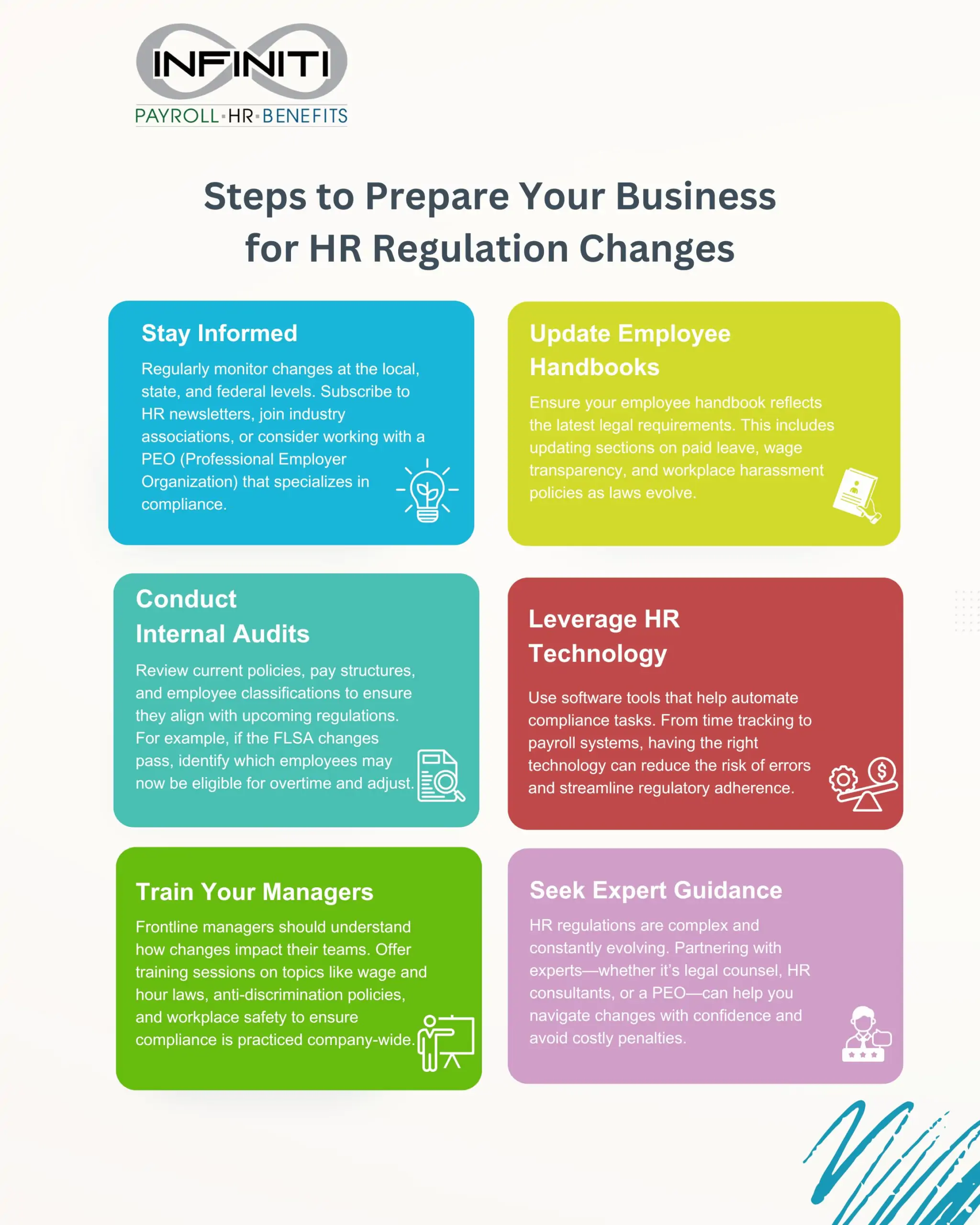
Infographic: Steps to Prepare Your Business for HR Regulation Changes


Getting Your Business Ready for Upcoming Government Regulations

When new government regulations and labor laws come into effect, adjusting to them can require initial expert guidance and eventual case law to interpret how those laws affect employers in the long term. The best way to prepare for these changes is to take a highly proactive approach.

Take the Time to Learn Existing HR Laws

Before diving into the new laws and regulations, you need to gain a solid understanding of the existing laws that govern your industry.

This will provide a foundation for analyzing how the new regulations may impact your business operations. Conducting a thorough review of the current human resource laws that apply to your industry allows you to ensure full compliance.

If you are not already in compliance when changes arrive, all existing non-compliance issues can snowball into significant problems that lead to unexpected expenses.

Set Up a Strong HR Infrastructure

Establishing a strong HR infrastructure can make it easier for you to adjust to the new regulations. When you have a team of specialists who know exactly what they are responsible for, they can handle any change seamlessly.

Small human resource teams that are overwhelmed with payroll, benefits administration, pension funds, occupational safety and health needs, and other manual administrative tasks rarely have sufficient resources to handle compliance properly.

When laws and regulations change, weak infrastructures struggle. Without a strong approach to your HR framework, you risk hurting business operations. 

Get Assistance from HR Partners

Seeking assistance from competent specialists, such as consultants who specialize in HR compliance, can be invaluable in navigating new government regulations. These experts can provide guidance on the ever-changing requirements, help you understand the implications of the new regulations, and assist with implementing necessary changes.

They can also keep you informed about any updates or changes to regulations that may affect your business specifically. A reliable HR partner is a team of professionals who have the time and resources to handle continuous monitoring of the regulation landscape.

For example, an HR partner would know that the temporary flexibilities for I-9 forms are about to end and help you set up a procedure for verifying employee identity and authorization in advance. At the time ICE announced changes, your company would have already been on the way to completing the new requirements.  

Rule Out Regulations That Don’t Affect You

Not all new regulations directly impact your business. Carefully evaluate and determine which laws are applicable to your specific industry and business operations.

By ruling out regulations that don’t affect you, you can focus your resources on understanding the laws that truly matter. This can help streamline your preparation efforts and avoid unnecessary compliance burdens. 

Stay Informed and Plan Ahead

Government regulations are always subject to change. Some may stay the same for decades while others change monthly. To avoid stress, errors, and fines, you can monitor the landscape by:

  • Reading industry news
  • Checking government websites
  • Joining professional associations and following their discussions

The more resources you use to stay informed, the more likely you are to pinpoint the change the moment it occurs. By planning ahead and anticipating potential regulatory shifts, you can position your business to adapt efficiently. 

Train and Educate Your Employees

When changes occur, your team has to be ready to tackle the issue quickly without causing downtime or facing non-compliance. To respond effectively, your workforce requires training. If you are working with an HR partner, they can share valuable knowledge with your employees and empower them to adjust to the changes. 

In addition, encourage open communication and provide channels for employees to ask questions or seek clarification on the new regulations.

Taking a Proactive Approach 

Staying on top of the latest regulations is a full-time job, often requiring significant adjustments to your HR processes when changes occur. Rushing or not being thoughtful in adapting leads to errors, fines, and reputational issues. 

As you can see with the I-9 updates, two new announcements were published within one month. If you don’t have the resources to handle active and ongoing monitoring, you may want to consider collaborating with an HR partner you can trust.

New regulations often appear as a reaction to an employer who did something wrong.  Becoming a test-case for new regulation is something you want to avoid. Getting back on track and regaining your reputation can be close to impossible. 

At INFINITI HR, we proactively monitor all the latest HR legislation changes and help our clients adjust to them without missing deadlines. For more information about our ability to help your HR succeed, please contact our team at any convenient time.

Interested in other current employment trends? Click the link to view the recent blog: Labor Law for January 2025 or check back for more on human resources, payroll, insurance, and benefits.

This article does not constitute legal advice, and there are subtle variations in employment law as it pertains to these topics, depending on where your business operates. It is strongly suggested that you seek consultation or legal counsel before making decisions about policies.

Labor Law Updates for January 2025

Please note: This blog is for informational purposes only. Employers should consult with  your HR Consultant or legal counsel to address specific requirements for their organization. Find past updates and insights on our website

Key Topics This Month:

  1. Massachusetts: Expanded sick leave, EEO reporting, and pay disclosure requirements.
  2. Michigan: New sick time law replacing the Paid Medical Leave Act.
  3. New Jersey & Vermont: Pay transparency mandates.

Massachusetts: Expanded Sick Leave and Pay Transparency

Expanded Sick Leave Qualifying Reasons – Effective November 21, 2024

Massachusetts has broadened the qualifying reasons for state-mandated sick leave. In addition to existing uses, employees may now use sick leave to address the physical, mental, or legal effects of pregnancy loss, failed surrogacy, adoption, or assisted reproduction. Employers should update handbooks and train managers to ensure compliance with these changes.

More Information on Massachusetts Earned Sick Time

Expanded EEO Reporting Requirements – Effective February 1, 2025

The law requires employers with 100 or more employees to submit an annual “aggregate wage data report” with demographic and wage information categorized by race, ethnicity, sex, and job role. This reporting is intended to enhance pay equity and transparency. Unions, schools, and governments must file these reports biennially. This year the deadline to submit will fall on February 3, 2025.

Pay Disclosure Law – Effective October 29, 2025

Employers with 25+ employees must include pay ranges in all job postings and advertisements. The law defines “pay range” as the range of an annual salary or hourly wage an employer reasonably expects to pay in good faith for the position at the time of the job posting.

Additionally, qualifying employers are required to:

  • Provide pay ranges to employees or applicants upon request.
  • Share pay ranges with employees offered a promotion or transfer.

Michigan: Earned Sick Time Act (ESTA)

Effective February 21, 2025

Michigan’s ESTA will require employers to provide 72 hours of annual sick leave, replacing the Paid Medical Leave Act for employers with 50+ employees. For smaller employers—those with less than 10 employees—at least 40 of the 72 hours must be paid sick leave. Employers with more than 10 employees must offer paid leave for all 72 hours of offered sick leave.

Details include:

  • Accrual Rate: Employees earn sick leave by accruing 1 hour for every 30 hours worked, with optional front-loading.
  • Accrual State Date: Accrual under ESTA begins on February 21, 2025.
  • Carryover: Unused sick time must be carried over to the following year.
  • Using Sick Time: Valid use of sick time can include caring for an employee’s own mental or physical illness, injury or health condition, or preventative medical care, or for that of their family member.
  • Documentation: When employees use sick leave for three or more consecutive days an employer may require reasonable documentation.

Employers should review current policies to ensure they meet or exceed ESTA standards.

More Information on ESTA

New Jersey: Pay Disclosure Law – Effective June 1, 2025

New Jersey employers with more than 10 employees will need to:

  • Include pay ranges in all job postings.
  • Notify current employees of promotion opportunities within affected departments before making decisions.

The law defines “promotion” as a change in job title and increased compensation. Employers should evaluate internal promotion practices to ensure compliance.

Vermont: Pay Transparency Requirements – Effective July 1, 2025

Vermont’s new law applies to employers with five or more employees. Job postings must include:

  • The minimum and maximum annual salary or hourly pay range.
  • Whether the role is tipped, along with the base hourly rate of pay.

For commission-based positions, employers are not required to disclose the pay range. Businesses with remote roles supporting Vermont locations should also comply with this law.

Interested in other current employment trends? Click the link to view the recent blog: HR Solutions for 2025: Tackle Hiring,Performance, and Remote Work or check back for more on human resources, payroll, insurance, and benefits.

This article does not constitute legal advice, and there are subtle variations in employment law as it pertains to these topics, depending on where your business operates. It is strongly suggested that you seek consultation or legal counsel before making decisions about policies.