Communication Skills for Leaders

The scenario is familiar: a stellar performer is promoted into management… only to crash and burn. So, why does this happen again and again? And what can businesses do to prevent it?

Recognizing the Value of Soft Skills

It is true that not everyone is born with the exact set of skills to be a great leader. In fact, hardly anyone is. As the axiom says, great leaders are not born, they are made.

Developing exceptional technical skills in a chosen career field is certainly one way to build toward a leadership position, but companies are realizing this type of direct experience is not the end-all of qualifications. In fact, in some cases it can be one of the least important factors.

Decades of organizational research shows “soft skills” are just as important as hard skills, if not more so. Soft skills are, by definition, someone’s interpersonal skills.  They are the skills that you can’t infer from reading through a resume, for example, but that are abundantly clear during a job interview or any other face-to-face meeting.

In a 2016 Deloitte survey, more than 90% of respondents rated soft skills as a “critical priority”. Soft skills can improve the reputation and effectiveness of leadership, increase levels of employee retention, and foster an engaging and dynamic company culture. And it follows to reason that the lack of soft skills by a company’s leadership will negatively impact those same areas.

Communication: The Foundational Soft Skill

It is helpful to think of communication as the foundational soft skill, the one that all others are built upon. If an individual cannot express themselves, their ideas, or their vision, they are ill-equipped to lead a team.

When most of us hear the phase ‘communication skills’, the default assumption is that the person is talking is referencing verbal skills. After all, verbal communication is the most immediately obvious of all communication skills and the one that is often assumed to propel someone into leadership. Everyone knows that leaders must be articulate and persuasive.

But there the category of communication skills is a broad one that includes both verbal and nonverbal communication. So, what do these skills look like in action?

Effective Communication – Leadership Edition

Clearly, it is the job of leadership to communicate the mission, vision, and goals of the company to workforce they lead and the outside world. But this essential communication is actually built upon the foundation of smaller, more intimate, communication skills and behaviors:

  • Set and communicate clear goalsSMART goals are proven work best, but even the best goals fall flat if they aren’t properly communicated and understood by your team, and if their missteps are not addressed.
  • Control meeting length. There may be no easier way to build appreciation among your staff than to eliminate needless meetings and keep the essential ones to a minimum. If you are leading the meeting, control the message, and keep the conversation on point and relevant. If you’re not in the lead, still do your best to support those goals and demonstrate to all that you value their time.
  • Stop talking. Believe it or not, sometimes exceptional verbal communication skills are actually detrimental to leadership. Do you have a reputation as someone who likes the sound of their own voice? Remember that communication isn’t all about what emanates from and out of you. Listening to others is a full 50% of the communication process.
  • Tailor your message. This is also referred to as knowing your audience. The best leaders can sense when their intended message isn’t getting through – usually by reading the non-verbal communication cues in the room – and change tactics midstream.
  • Build rapport. Demonstrate empathy and communicate on a personal level with your team. This non-business communication doesn’t have to be excessive, but it must come from a genuine place.
  • Be a trusted voice. Set an example of honesty. If you’re not an expert on a given topic, don’t present yourself as one. An honest communicator can say, “I don’t know, but I can get back to you,” or “That’s a great question, let’s bring in Marie, who is a subject matter expert.”
  • Communicating praise and appreciation. In the example above, did Marie help you close a deal or keep a current customer happy? Thank her publicly and, ideally, in writing so it can be passed around. Good leaders praise and share accolades with their team.

For business leaders, effective communication is multi-faceted skill that may take time to develop, but one that can yield rewards to those who commit to it.

Click the link to view the recent blog: How to Build Trust with Your Employees or check back for more on human resources, payroll, insurance, and benefits.
How to Build Trust with Your Employees

A 2017 national survey conducted by Ultimate Software and the Center for Generational Kinetics (CGK) showed that 93% of employees stated that trust in their direct boss is “essential to staying satisfied at work” and half of those employees relayed that without trust in their managers, they don’t put forth their best work.

Gallup data from 2015 showed that managers account for 70% of variance in employee engagement levels, and disengaged employees are employees who leave the company and take talented employees with them.

Managers who have been trained and coached for leadership have the best chance of rallying their departments to do their best work. Unfortunately, all too often, individuals are dropped or promoted into positions without really knowing how to manage or lead teams due to an opening that needs to be filled or seniority. Inexperienced managers who have not been coached can have disastrous effects on a team.

Experienced managers who erode the trust their employees have in them can be just as devastating.

So what are some of the do’s and don’ts of building that trust?

Don’t:

  • Push off the blame – a manager who throws his/her team under the proverbial bus for project challenges/failures will be hard-pressed to gain (or regain) any employee trust. Recognize the part you may have played in lack of teamwork or organization.
  • Take all the credit – Nothing will push away employees faster than a manager who accepts accolades for work he or she didn’t actually do.
  • Make promises – If you don’t have final authority on decisions, having a promise fall through (salary adjustments, promotions, bonuses) doesn’t lend itself to credibility.
  • Gossip – managers who overshare about their colleagues or other subordinates will usually instantly affect employee relations, leaving their own team wondering what this manager may be sharing about them.
  • Micromanage – if you have professionals working for you who are comfortable with their roles, let them do what you hired them to do. Lead, don’t manage.

And what CAN a manager do?

  • Be honest – If you don’t have all of the answers, don’t be afraid to say so. Be straightforward and respectful. Have those hard conversations with employees whose performance level needs improvement.
  • Apologize – If you make a mistake, admit it and whenever possible, make it right.
  • Show interest – Taking a personal interest in their employees, their hobbies, and their goals, can go a long way toward building a relationship of trust with the team.
  • REALLY listen and Act – When your employees are dealing with obstacles at work, listen and ask questions to identify the problems you can tackle and block at a higher level so they can move forward.
  • Be responsive – Answering your employee’s emails, texts, and voicemails in a timely manner can be crucial to developing confidence among your employees that you have their back, and that you will not be an obstacle to their ability to do their jobs.
  • Roll up your sleeves – the team has to stay late to complete a project? Watching a manager walk out the door as the rest of the team prepares to dive in can be a huge hit to morale.
  • Check in – regularly scheduled (and kept) weekly or biweekly meetings will let you keep in touch with your team, talk about career goals, and help you to be aware of any issues before they escalate.

Employees are generally looking for a supportive leader, not just a “boss,” and will stand behind a leader they trust.  If employees don’t trust the one who is supposed to lead them, they will look elsewhere for opportunities and take all of their talent and knowledge to benefit someone else.

Click the link to view the recent blog: FLSA – What’s New and What’s Not? or check back for more on human resources, payroll, insurance, and benefits.

FLSA – What’s New and What’s Not?

The Department of Labor has finally released its 2019 “Final Rule,” delimiting exemptions from the Overtime Provisions of the Fair Labor Standards Act (FLSA).

“Huh?” (scratches head)… Yes, that is a frequent response.

Labor law has never been written to be easily understood.  Don’t fret! We’ll try to make it simple for you.

WHAT’S THE GIST?

In an attempt to boost the income of what they project to be more than 1.3 million workers, the Department of Labor (DOL) raised the salary threshold to be exempt from the provisions of the Fair Labor Standards Act (FLSA), which most employers and employees recognize as being exempt from being paid overtime (OT) when working more than 40 hours in a week, effective January 1, 2020.

We should note that where state laws are more strict or generous on OT than federal standards, state law would govern. But for now, let’s focus on how this recent change affects FEDERAL OT rules.

WHAT’S NOT NEW?

To be free from the obligation of paying overtime (EXEMPT), a job must meet TWO criteria. If the job doesn’t meet both requirements, you must pay OT (NON-EXEMPT).

The two criteria are:

  1. An employee’s Job Duties, and
  2. Compensation

JOB DUTIES

This is where many employers have always erred. Title alone does not satisfy the first criteria. If the DOL decides to question who you classified as exempt, they will drill deeper into the day to day activities that an employee engages in.

How are exemptions (from OT) determined?

The DOL has established criteria for categories of “exempt positions” and outlines them in Fact Sheets.  The job duties (not the title) are compared to the fact sheets, and if all the requirements are met, the position may qualify for exemption from paying OT. Available to the public, the expansive list can be found here: DOL Website – Fact SheetsFact sheet #17A is a particularly handy one.

Our recommendation is to start by taking your updated, accurate job descriptions and compare them to the various fact sheets to see if there is a match to pass the first criteria.

You don’t have job descriptions? This is one of the many reasons you need them. A good read to consider:  Five Key Elements of Job Descriptions.            

Certain types of work are never eligible for exemption, such as production, maintenance, construction, or repetitive operations using hands and physical skill. Other types of work have special exemptions, such as Outside Sales, and some Computer Related Occupations.

WHAT IS NEW?

COMPENSATION

Once you have determined that a position meets the job duties criteria for exemption, you need to review the compensation.

This is where the Final Rule shakes things up more than a bit.

  • Until January 1, 2020, assuming they meet the job duties aspect, employees can be defined as exempt from overtime pay if they are paid a salary of $455 or more per week (annualized that’s only $23,660). We’ll call that the standard salary level.
  • After January 1, 2020, of the standard salary level increases to $684 a WEEK or more (annualized, that’s $35,568).

In the past, the math was easy, you either did or did not pay a salary of at least $455 a week. Period. But also effective 1/1/20, the DOL has thrown in a new option for organizations who are interested in more complex exempt pay programs:

  • Up to 10% of the new standard salary level can be made up of non-discretionary bonuses, incentives or commissions, so long as they are paid at least annually.
  • The DOL has also introduced the concept of catch-up provisions when employees fail to earn sufficient non-discretionary payments.

This new option in the FLSA compensation calculation requires much more attention to detail, advanced planning, and periodic auditing to ensure you’re on track to meet the threshold.

Please note, employers DO NOT have to offer non-discretionary and catch up payments if they don’t want to. For simplicity, you can stick to a plain ‘ole fashioned salary of $684 a week or more to meet the compensation criteria.

HIGHLY COMPENSATED EMPLOYEE CHANGE

Highly Compensated (HC) refers to a group of employees who are compensated above a certain threshold.  Their compensation is so significant, they may be classified as exempt with more lenient expectations than set in the Fact Sheets, with the exception of specific job types set by the DOL.

  • In the past, HC employees who made more than $100,000 annually (of which at least $455 a week must be salary) could be classified as exempt if they met most, if not all, of the job duties outlined in a Fact Sheet. Careful analysis still has to be made for each job in making this decision.
  • As of January 1, 2020, this minimum compensation moves to $107,432 per year (of which at least $684 a week must be salary).

The new HC employee test does NOT allow employers to credit non-discretionary bonuses or incentive payments (including commissions) towards the standard salary level, but the rest of the compensation can be incentives.

WHAT NEXT?

Employers who have not already audited their situation should do so quickly.  Things to keep in mind:

  • If you have employees who are exempt, but will not meet the new threshold, you need to decide: Do I give them a raise? Or, do I start paying them overtime when they work more than 40 hours in any given pay week? The choice is yours.
  • Regardless of which approach you take, effective planning and communication will be important to maintain morale. Moving from salaried to hourly might be perceived as a demotion by some.  Also, if you give raises to certain employees to meet the new threshold, other employees may not understand why they did not receive a raise.

It’s still a lot to take in. We get that.

Click the link to view the recent blog: Labor Law Updates for February 2020 or check back for more on human resources, payroll, insurance, and benefits.

Labor Law Updates for February 2020

INFINITI HR and Inspiring HR are excited to introduce a new feature as a service to our subscribers:  Monthly State Law Updates! These briefs provide a general description and are not meant to be all inclusive of compliance requirements. This list is not inclusive of all legislative changes for employers across the U.S. Changes may have been addressed in previous updates, which can be accessed online on inspiringhr.com.

Employers are encouraged to work with their Inspiring HR Consultant before making policy changes to capture the full requirements of these laws.

FEDERAL CHANGES:

Revised Form W-4 – effective January 2020

Employers received both a big visual change and a new approach with the release of the newest form W-4.

It’s the first major redesign in over 30 years, but with the implementation of the Tax Cuts and Jobs Act which eliminated personal and dependent exemptions, and increased both the standard deduction and child tax credit, the form needed to be updated.

The new version includes a five-step process to help employees determine withholding by including areas to address multiple jobs and two-earner families, as well as aligning the number of dependents with the amount of the federal tax credit.

Any employee hired on or after January 1, 2020 must complete the new form. Employees hired before January 1 will not be required to fill in the new form unless they want to make changes to their existing withholding.

Employers and employees with questions about the form can review resources on the IRS website.

Revised Form I-9 – Released January 31, 2020

On January 31, 2020 the USCIS published a new version of Form I-9, Employment Eligibility Verification.  This new version has minor changes to the form and its instructions.

All employers should begin using this updated form as of January 31, 2020.

However, the notice provides employers additional time to make necessary updates and adjust their business processes. Employers may continue using the prior version of the form (Rev. 07/17/2017 N) until April 30, 2020 if needed. After that date, they can only use the new form with the 10/21/2019 version date. The version date is located in the lower left corner of the form.

SOME OF THE NOTABLE UPCOMING STATE CHANGES IN THIS ISSUE ARE AS FOLLOWS:

Illinois: 

Prevention of Harassment Training – effective January 2020

https://www2.illinois.gov/Pages/news-item.aspx?ReleaseID=20435

The amended IHRA requires the Illinois Department of Human Rights (IDHR) to produce a model training program for the prevention of sexual harassment. The model program will be available online to employers and the public. Every employer with employees working in Illinois must use the model program or establish a program that “equals or exceeds” the statutory standards for the IDHR’s program.

Those standards require, at a minimum, an explanation of sexual harassment, examples of unlawful conduct, a summary of relevant federal and state statutes, and a summary of employer responsibilities. Employers must provide this training to all employees at least once a year.

The new training requirements do not apply to state employers that are subject to the sexual harassment training requirements in the State Officials and Employees Ethics Act.

Pennsylvania – Philadelphia

Philadelphia, PA Fair Workweek Act

On April 1, 2020, all Philadelphia employers in the retail, fast food or hospitality industry that have 250 or more employees and 30 or more locations worldwide, will be required to provide advance notice to all employees as follows:

  • Provide all new employees with a written estimate of their work schedule, which includes the average number of hours the employee is expected to work each week;
  • Provide all employees at least ten (10) days (will increase to 14 days 1/1/2021) advance notice of their work schedule;
  • Notify any employee of any schedule changes as far in advance as possible prior to the change in schedule;
  • Consider employee work schedule requests, including any requests not be scheduled for specific times and/or locations.

Employees are defined as all full time, part time, temporary and seasonal employees.

Employers are permitted to make changes to any schedule within 24 hours of the original schedule.  Any schedule changes made after the first 24 hours will be subject to “predictability pay,” which is determined by the employee’s hourly rate of pay.  The predictability pay must be provided to any employee who’s scheduled is changed.  Employees must be provided a “right to rest” between shifts; therefore, employees may refuse the additional scheduled shift if there is less than nine (9) hours of rest between shifts.  If the employee chooses to accept the additional shift, they are entitled to an additional $40 hours of pay.

Employers will be required to provide a notice of the law to all employees and will be subject to record retention requirements.  The notice has not been released yet.

New Jersey

New Jersey Crown Act – Law Against Discrimination

The New Jersey, “Create a Respectful and Open Workplace for Natural Hair” (CROWN) Act became effective on December 19, 2019.

The CROWN Act expands the New Jersey Law Against Discrimination (LAD) law, which protects employees and potential employees from discrimination due to race, including traits historically associated with race, such as hair texture, hair type and protective hairstyles.  The CROWN Act prohibits employers from enforcing an appearance policy that restricts or forbids an employee’s hairstyle that may be associated with race, such as twists, braids, cornrows, Afros, locks, Bantu knots and fades.

New Jersey employers are encouraged to review the Division on Civil Rights “Guidance on Race Discrimination Based on Hairstyle,” for guidance on the CROWN Act applies to their business.  Employers are also advised to review their Grooming and/or Appearance Policies, if any, to determine if the policy language in is violation of the new law protections.

New York

New York Minimum Wage and Exempt Salary Threshold Increases

Effective December 31, 2019, New York minimum wage and exempt salary thresholds increased.  All employers are required to comply with the new minimum wage and exempt salary requirements as defined below:

Employer Location Minimum Wage Exempt Salary Minimum Threshold
NYC Employers $15.00/hour $1,125.00/week$58,500/annually
Nassau, Suffolk & Westchester County $13.00/hour $975.00/week$50,700/annually
The remainder of NY $11.80/hour $885.00/week$46,020/annually

 Employers are encouraged to review their employees’ pay rates and exempt positions to determine if the work they are doing meet the minimum wage requirements and duties test that exempt them from overtime.  Employee pay rates and/or salaries may need to be adjusted across the board.  If an employee doesn’t meet the exempt duties test, he/she must be changed from non-exempt and start earning overtime pay as noted above.

Click the link to view the recent blog: Trends in Marijuana and Employment or check back for more on human resources, payroll, insurance, and benefits.

This post does not constitute legal advice and there are subtle variations in employment law as it pertains to these topics, depending on where your business operates. It is strongly suggested that you seek HR consultation or legal counsel before making decisions about policies.

Trends in Marijuana and Employment

Employers, Take Note:

More states have passed laws related to the purchase, possession, and use of marijuana and its impact on hiring and employment than not. Meaning most employers in the U.S. may have obligations for policies and practices that address this issue appropriately in their respective states.

Legislative Highlights in 2019

Most recently, Nevada and New York City have made it unlawful to test for marijuana use prior to starting employment in most positions that do not have a safety or security component (e.g. drivers of vehicles, emergency personnel) and Oklahoma has amended its medical marijuana laws to specify that employees in safety-sensitive positions may not be eligible for accommodation for its use.

New Jersey passed CUMCA (Compassionate Use Medical Cannabis Act), which prohibits discrimination in hiring and/or conditions of employment against individuals who are registered medical marijuana users and joins eight other states with similar prohibitions.

According to the National Conference of State Legislatures, roughly 33 states (and Washington D.C.) have legalized medical or recreational marijuana – or both. What does this mean for business owners?

What Business Leaders Should Be Prepared to Do

While as of this posting no states have passed laws expressly allowing employees to use marijuana at work (or report to work impaired due to pre-shift use), we recommend the following:

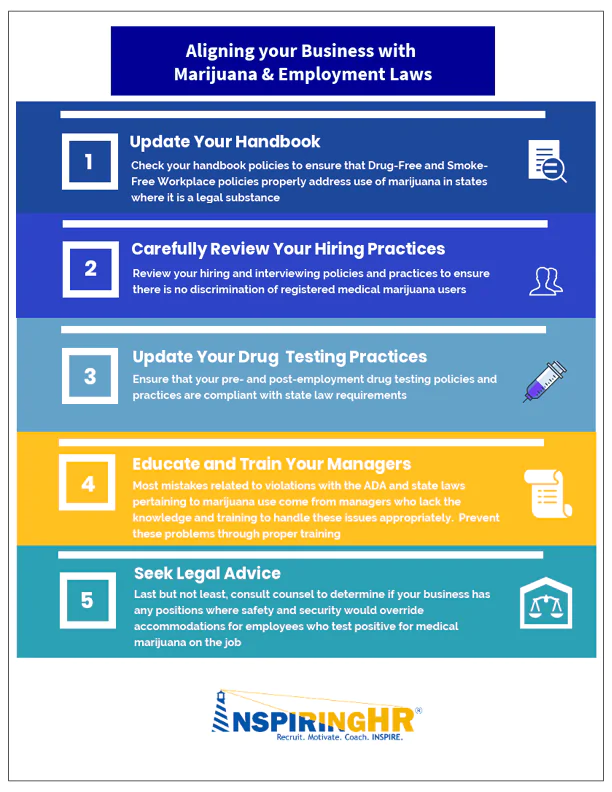
  • Check your handbook policies to ensure that drug free and smoke free workplace policies properly address use of marijuana in states where it is a legal substance.
  • Ensure that your pre and post-employment drug testing is compliant with state law requirements.
  • Review your hiring and interviewing policies and practices to ensure there is no discrimination of registered medical marijuana users.
  • Educate and train your managers on the proper application of your testing policies and how to properly route accommodation requests related to marijuana use and test results.
  • Last but not least, consult counsel to determine if your business has any positions where safety and security would override accommodations for employees who test positive for medical marijuana on the job.

trends in marijuana and employment

Click the link to view the recent blog: Top Five HR Trends to Expect in 2020 or check back for more on human resources, payroll, insurance, and benefits.

This article does not constitute legal advice and there are subtle variations in employment law as it pertains to this topic, depending on where your business operates. It is strongly suggested that you seek consultation or legal counsel before making decisions about policies.


Top Five HR Trends to Expect in 2020

As the workplace dynamics change, so does HR, and 2020 will be full of change that requires a paradigm shift in how we communicate and partner. Join us and Inspiring HR as we break down the changes we anticipate for small business and how business leaders can prepare for the new year:

  1. HR Outsourcing Takes Over –HR professionals are seeing a major shift from employing internal HR professionals to outsourcing all or most HR functions. The expense to employ HR professionals is much greater than outsourcing HR responsibilities to HR consultants who specialize in learning, interpreting, and developing policies and procedures in accordance with new and updated federal and state employment laws and regulations. Businesses are creating business partners or strategic partnerships with qualified HR specialists to assist with day-to-day HR issues.
  2. Flexible and Remote Work Becomes Permanent – The workforce is starting to require more flexible work weeks and remote work options that are in alignment with more modern work trends. Business owners are finding success in making more roles within their business flexible and/or remote-based. As a result, more employees are working flexible work weeks, such as working three to four days per week instead of the typical five day standard and/or working 30 hours a week versus the standard 40-hour work week as we’ve seen in the past. Working a flexible schedule and/or remotely has proven to be successful and more cost effective for many business owners. As we move into the new year, business owners will begin to shift more traditional office roles to remote roles.
  3. Employee Engagement is More Important – A popular trend in 2019 will continue to develop into 2020, which is employee engagement. By engaging employees within the workplace, business owners are finding that employees are more willing to work harder for the success of the business. When employees are engaged, they feel important and valued to the business. As a result, employers are finding that engaged employees are easier to retain; therefore, reducing turnover.
  4. Social Media and Artificial Intelligence Drives Several HR Functions – Since the inception of social media platforms, business owners have seen a major change in how they handle recruiting, marketing, branding, etc. Social media platforms are driving the success of each of these functions, especially in recruiting where everything is now digitized from the job posting to presenting an offer of employment. Many recruiters and potential candidates now regularly communicate electronically throughout the recruiting process. Social media is also a great resource for businesses to develop and communicate company brand standards and reputation to potential clients and employees.  The evolution of social media in business will continue to change how you operate and interact with employees and customers.
  5. Ongoing Performance Management –Business owners have been moving away from the “annual review” process and instead benefiting from ongoing performance feedback to employees. This may look like weekly or bi-weekly one-to-ones to discuss successes, obstacles, achievements, deficiencies, etc.  Not only do these frequent feedback sessions do a better job of staying ahead of any major performance issues by addressing them immediately, they also promote greater employee retention and increased performance for incoming generations that are accustomed to more open and immediate data electronically, through social media and in gaming platforms.

HOW CAN SMALL BUSINESSES KEEP UP?

  • Assess your current HR function and how it relates to organizational needs. Is the internal HR function(s) necessary or could an outsourced HR strategic partnership provide greater value to the business? Would an outsourced strategic partnership free up financial resources and day-to-day administration to allow for expansion and growth? If your Internal HR function is effective and delivering value – keep it! If not, be open to options.
  • Review and compare your company core values, mission statement and vision against upcoming workplace trends. Do they align? Or do they require a different perspective such as moving from a standard work schedule to a flex schedule or remote work?
  • Identify and implement new approaches to employee engagement and ongoing performance management where possible and necessary. If you want increased engagement and open communication, you can’t be reactive or stagnant.
  • Don’t be afraid to test and implement new social media platforms to drive recruiting, branding, and marketing efforts. So many options exist, you WILL find an option that best suits your individual company for a cost that meets your budget.

Click the link to view the recent blog: Another Update to the Definition of “Joint Employment” or check back for more on human resources, payroll, insurance and benefits.

Inspiring HR employs a group of certified HR professionals with experience ranging from specialization in Labor Union contracts to more traditional corporate culture. Their HR professionals strive to balance, simplify, understand, empower and ensure relevance by instilling an “HR Done Differently” approach.  

Another Update to the Definition of “Joint Employment”

A food franchise’s employees are confused.

While they understand their location has its own owners, they were interviewed at least once by the corporate office during the hiring process and the handbook they were given appears to be from corporate as well. While most of the content seems to apply, it also contains operational and procedural information that is contrary to what they were told during at their worksite during orientation and did not mention the name of the separate entity that employs them.

A second location, also run by the same owners, lends employees to the original location when they are short-staffed and vice versa. While the total employee count does not normally matter to the workers, one employee noticed that minimum wage in their city differed based on employee count. When she approached the owners, they let her know that the count was per location as they were separate business entities, so they didn’t qualify for the higher minimum wage.  The employee reached out to corporate and was told they did not have control over how the franchise owner paid.

Joint employment… or not?

Joint employment, put simply (and explained in a previous blog post), is found to exist where two separate legal entities share the ability to control or determine essential terms and conditions of employment including hiring, firing, disciplining, supervising, scheduling, and directing employees. And per the FLSA, “A determination of whether the employment by the employers is to be considered joint employment or separate and distinct employment for purposes of the act depends upon all the facts in the particular case”.

The Browning-Ferris joint employment standard, that came into effect during President Obama’s administration, expanded the definition to include companies that have “indirect control” over employees which could include a franchisor relationship with its franchisees or a distant parent company with one of its entity companies, even if they are not involved in the day-to-day operations of the business. It was briefly overturned in 2017, however, another reversal in February of 2018 has brought it back into effect.  This means that employers are once again subject to the expanded definition of what it means to be a joint employer, that of direct or indirect control over an entity and its employees.

What’s next?

The Save Local Business Act, which has been in the Senate since late 2017, seeks to solidify the definition of joint employment to limit it only to companies who have “direct control” over their employees. This would limit liability for wage and hour and other internal decisions and workplace issues to the direct employer alone. In the meantime, the current expanded definition stands.

What should employers do?

Companies with franchises or far-removed entities should continue to monitor and carefully examine their employment practices and the amount of involvement and control they have in staffing, scheduling, and wage and hour decisions of their day-to-day operations. It may be advisable to seek the opinion of legal counsel as to whether a particular relationship should be considered joint employment under the expanded definition.

Click the link to view the recent blog: The Possibilities of Commission Pay or check back for more on human resources, payroll, insurance and benefits.

Why Small Businesses Need a Competency-Based Hiring Strategy

Gather a group of small business owners in a room and you’ll hear this common complaint, “it’s hard to find good people.”

This phrase breaks my heart because there are plenty of skilled people dying to find a job in a company like yours. However, many small businesses miss the mark when they fail to consider competency-based hiring strategy.

Great candidates are highly selective. They want a job where the culture fits their personality and they can excel. As a small business owner, you share this goal: a high performer who fits your company culture. A competency-based hiring strategy lets you attract the right people and makes hiring easier.

Let’s start by defining competency. There are two types: (1) skills, knowledge, and technical qualifications, and (2) personality traits, behaviors, and attitudes. The first group is pretty straightforward. Most of us can easily identify the skills, knowledge, and experience needed. The second set of competencies is trickier for most of us.

Why? Because behaviors are hard to define. As humans, we tend to put difficult tasks at the bottom of our list. And we rarely get to the last items. That is a mistake when you are hiring people.

If you were buying a pricey piece of equipment, you would spend time looking at key features and how you could use them to make your processes faster, more efficient, or more productive.

Yet, when it comes to hiring people, we fail to spend time thinking about the most important behaviors of a successful employee. That can be the most expensive mistake you make. Especially when the result is often a bad hiring decision.

Defining behavioral competencies is surprisingly simple. However, it does take some careful thought.

Start by studying your high-performers. If you don’t have any, use someone from another company who you want to work for you. Think about their attitudes, behaviors, and personality traits and how those traits contribute to their success. Then create a pie chart with the top three to five attitudes and behaviors. Your chart is a snapshot of your company culture.

Now do the same for your low performing employees. This gives you a range of performance from low to high.

But you have a little more work to do. This is where things get tricky. Your task is to take these behaviors and turn them into daily work activities.

Your next step is to specifically define those attitudes and behaviors in your company. Words mean different things to different people so it is critical that everyone has a common understanding. Use clear, concise, and easily understood language. Remember you are writing for your audience, who may have a different definition than you. You want two strangers to understand these behaviors and rate them in the same way.

Is this starting to sound like a performance review? It should because defining these behaviors is at the heart of effective performance standards.

Do this for each key behavior or attitude. You might include examples of words and phrases that your employees use. Go deep here. The more specific the better.

This worthwhile exercise unlocks powerful insights you can use to attract high-performing employees. It gives you a solid foundation to craft strategic interview questions to ensure your candidates possess these competencies.

Clearly defined competencies continue to pay dividends after you hire as well because they can be used for setting goals, creating career paths, professional development opportunities, and so much more. Plus, an added bonus is reduced turnover and increased employee engagement and retention.

A competency-based hiring strategy does require time on the front end. However, you’ll find the investment is one of the best you can make for your business.

– Contributed by Rebecca Barnes-Hogg, guest blogger from our preferred partner, YOLO Insights®

Take the First Step.

If you still have some work to do, no worries. The important thing is you are ready to learn. Reach out to your Inspiring HR consultant for a free consultation and help.

You may also want to grab a copy of Rebecca’s book, The YOLO Principle: The Ultimate Hiring Guide for Small Business, available on Amazon.– A handy resource packed with tools, templates, and step-by-step instructions.

Click the link to view the recent blog: Make Delegation a Win-Win Experience or check back for more on human resources, payroll, insurance and benefits.

Make Delegation a Win-Win Experience

Have you ever been in this situation – you have numerous projects or responsibilities on your plate and you feel like it is up to you to accomplish them all?

You may have one or even several employees on your team, but you feel like you have to be the one who controls how and when everything gets done.

Why Are Some Managers Reluctant to Delegate Work?

There are several common reasons managers may be hesitant to delegate to others. These may include:

  • If I have to spend the time explaining to someone else what I need, I may as well do it myself.
  • I don’t know it will get done the way I would do it.
  • What if someone does it better than me?
  • I don’t know if my team has the right skill set.

These are just a few of the many reasons managers give to avoid delegating work to others. They may see it as a way to retain control, make sure they are seen as valuable to those above them (i.e. ensure they don’t delegate themselves out of a job), or want to make sure the work gets done right. There are others who may also struggle with the concept of “delegating versus dumping.”  They may think, “If I ask someone to take on this task, will it be perceived I’m just dumping work on them that I don’t want to do myself?”

BENEFITS OF DELEGATING

While it is often times easy to look at the downside of delegation, here are a few reasons why delegating to others can be a positive thing:

It can result in better trained employees – Delegation is a great way to put development opportunities in place for your employees. It helps them to grow and develop new skills.

Productivity may increase – Managers have the opportunity to be performing more strategic and high-level work by delegating other tasks to their employees.

Staff are more motivated, which may lead to increased retention – When employees feel like they are being empowered, growing in their roles, and given increased knowledge they will tend to stay with an organization longer. This also helps to establish a culture of trust that can lead to longevity of employees.

It saves time and money – As noted above, when managers delegate it saves them the time they would normally spend on certain tasks or responsibilities and allows them to focus on higher level work. By doing this, the company can pay a $25 per hour employee to do the task instead of paying the $45 per hour manager to do it.

In addition, by helping employees develop new skills, it puts them in a better position for promotional opportunities. When these occur, the transition into the new role may be smoother because of the skills the employee has already learned from these development opportunities.

It is also important to remember that when you delegate to employees you don’t just “dump” the work on them with no explanation. This is often where delegation goes wrong – employees get frustrated and the manager ends up saying, “See it didn’t work. I’ll just do it myself.”

In order for delegation to be effective, you need to be able to articulate to the employee specifically what needs to be done. In doing so it is important to give clear instructions and to discuss and agree on the resources that will be required, as well as perhaps even explaining what a successful outcome would look like. This is especially important if this is the first time the employee is performing this type of task.

Along the way one key component is to provide support and communication while not giving the impression of micro-managing. Depending on your personality style this could be a challenge but one way to do this is to “trust but verify.” This means trusting the employee to get the work done but verifying every so often the person is on schedule, especially as it gets closer to the time frame in which the work needs to be completed. This is also accomplished by providing timely feedback to the employee. This will allow the employee to feel supported and also help ease the mind of the manager that the work is getting done, leading to a win-win situation.

As scary as the thought of delegation may be, when done the right way with the right employees, the benefits should far outweigh the risks and result in a successful outcome for all.

Click the link to view the recent blog: Small Business Cybersecurity: Experts and Non-Experts Agree… and Disagree or check back for more on human resources, payroll, insurance and benefits.

Small Business Cybersecurity: Experts and Non-Experts Agree… and Disagree

Are you tired of hearing about data breaches yet?

Thought so. It seems the monthly data breach story has turned into the weekly data breach story. As our systems grow more complex, and we further integrate into the digital world, there are more opportunities for our sensitive data to be stolen. Additionally, cyber criminals are finding new ways to monetize their illicit activities, such as through ransomware and illicit dark web marketplaces where stolen data can be bought by identity thieves and sold by hackers. As a result, cybercriminals have never had so much opportunity and monetary incentive for their activities. So, for the foreseeable future, we can expect to see more of the same.

Unfortunately, human resource departments make great targets for cyber thieves because of the sensitive employee data they store, which may include:

W-2 data is especially valuable. If it is stolen, it can quickly be converted to ill-gotten gains by filing a fraudulent tax return, used to obtain a loan or credit cards, or any other variety of identity theft. Every tax year, we see dozens of reports about companies that fall victim to W-2 scams and accidentally send their employees’ W-2s to an attacker posing as an insider.

So, what can be done to minimize the risk of data theft from HR departments?

In 2015, three Google researchers published a study that highlights the differences in what experts and non-experts think are the top three things an internet user can do to stay safe online. There are many lessons from this that HR departments can leverage to improve their security. As you might expect, there are areas where experts and non-experts agree and others where there is a significant divergence. Let’s take a look at the key chart from this report and see what sort of lessons we can learn:


The chart above ranks, from left to right, the most effective to least effective cyber defenses according to experts and provides the corresponding perspective of non-experts. (Source)

1. Update System

The biggest lesson from this chart is the first metric shown on the left. One of the most effective cyber-defenses is staying up-to-date with your security patching, yet most people believe this to be unimportant. Many of the businesses that are victimized by ransomware and other cyber-attacks, are victimized because their systems are not patched with the latest security fixes that prevent those attacks from functioning.

Many modern exploits take advantage of weaknesses in Microsoft Office, Microsoft Windows, Adobe Acrobat/Reader (pdf files), Adobe Flash, and other popular software. These exploits are discovered by hackers and security researchers, and generally the big software vendors fix the exploits quickly. But we as users need to configure our software to allow for automatic updates, and, even though it is annoying, allow the updates to install and reboot the computers when practical so they are protected.

What is interesting is that the system update data point is roughly the inverse of “use antivirus.” I would speculate the divergence of thought between experts and non-experts is due to the non-experts having been exposed to antivirus as the center point of home cybersecurity for 20+ years. Antivirus is still a corporate cybersecurity necessity, but experts believe it to be less important than it was in the past, probably due to so many virus detection mechanisms that reside at network layers placed between users and the internet (such as in SPAM filters and firewalls).

2. Use Unique Passwords

In preparation for this article, I logged into my password manager to see how many sites for which I had login credentials stored. I was shocked to see that I had 184 sites stored.  That is 184 businesses that need to keep, maintain, and secure my account information. And there’s probably others not in there!

Many people reuse the same password at a number of websites because the human brain is not great at storing long strings of random characters. Let’s pretend I reuse the same password in each of those 184 sites. Then, let’s pretend one of those sites was hacked and my user ID, email, and password is stolen. That information will likely be sold on the dark web to identity thieves who would take that email, user ID, and password, and start using them to try to log into popular banks, trading accounts, email accounts, and others to try to gain access to sensitive information and ultimately try to monetize my data for themselves. By reusing the passwords in 184 websites, I have created the conditions for widespread damage if there is a data breach in only one.

By using unique passwords, we guarantee that if our user ID and password is stolen from one business, it cannot be used to gain access to another account at another website.

For HR staff who have access to benefits systems, payroll systems, and other systems that store sensitive data, are you using the same password to log into those systems as you use in other personal online accounts? If so, you might be increasing the risk of data theft to your fellow employees.

Okay, I need unique passwords. But how do I remember all these passwords? I alluded to it before; password managers can be great to generate and store long, complex, and unique passwords. A password manager securely stores your passwords in a way that makes them retrievable by you and hopefully nobody else. They generally also have user conveniences that make it so that you don’t have to manually key in the long password.

What happens if the password manager gets hacked? This is a valid concern and ultimately it boils down to a personal decision. You have to ask yourself if you think the security benefit from having long, complex, and unique passwords from a password manager is greater than the risk that the password manager is hacked and all the data is stolen and decrypted.

The general consensus among security experts is that the benefit does outweigh the risk. Just looking at the chart above, we can see that four of the top five recommendations all relate to having strong authentication, and number five is “use a password manager.”

3. Use two-factor authentication

Another area of great divergence between experts and non-experts relates to something called two-factor authentication (2FA), also sometimes called multi-factor authentication (MFA). Most 2FA solutions typically require three pieces of information from users to access their accounts:

  • a user ID (something the user knows)
  • a password (something the user knows)
  • a token of some variety that is generated by a device carried by the user (something the user has)

The third item can be an access card, a mobile phone, or a key fob with a rotating pin code. Here’s an example of how they work:

You visit a website, enter your user ID and password, and authenticate. The website sends a temporary authorization pin code to your mobile phone in a text message. You receive the text on your phone, enter the pin code into the website, and access the account online. Without your phone, you would not have been able to log in.

A cybersecurity attacker who wants to bypass these protections needs more than just your user ID and password; they also need a physical device. With 2FA, the risk of unauthorized access from stolen or sold login credentials is greatly reduced. And yes, employees do sell passwords.

The great news with 2FA is that it is becoming more widely adopted every day. Many of the HR systems providers, such as payroll and benefits websites, offer the option to set up 2FA quickly and easily. HR departments should look into the online systems they use and try to enable 2FA if it is an available function. If it is not available, try to encourage your service provider to add the capability. User feedback is critical for developers to improve software.

There is obviously much more to think about with respect to corporate cybersecurity, but HR departments would be wise to consider the highly rated security measures identified by Google and discussed in this article to help keep their data safe.

Article contributed to Inspiring HR, LLC by Chris Moschella, CPA, CISA with Keiter.  

Keiter provides a wide-variety of cybersecurity services to their clients including, but not limited to: cybersecurity risk assessments, policy analysis, audit, penetration testing and vulnerability scanning, security awareness testing, custom phishing campaigns, and more. You can also check out Keiter’s collection of free cybersecurity resources. Organizations ready to tackle cybersecurity for the entire business can download Keiter’s free whitepaper.

Click the link to view the recent blog: Ditching the Annual Review or check back for more on human resources, payroll, insurance and benefits.