

The Truth About Employer Liability Risks: HR Compliance Gaps That Lead to Costly Penalties
Nobody plans to get sued. Yet many companies face lawsuits because of employer liability risks and HR compliance gaps they never realized existed.
You hire good people. You pay them on time. You try to do right by your team. But small compliance gaps can quickly turn into employment law penalties, Department of Labor investigations, and costly employer liability claims.
That’s the reality of employment law compliance for employers. It doesn’t care about your intentions. It doesn’t grade on effort. And it definitely doesn’t wait until you’re ready to deal with it.
Quick Answer: Employer liability risks usually come from everyday gaps, like inconsistent attendance policies, worker misclassification, and incomplete documentation, not deliberate rule-breaking. A single misclassified worker can trigger an audit of your entire workforce. Partnering with a PEO or HR consulting firm helps small businesses build the systematic compliance infrastructure needed to catch these gaps before they become costly penalties.
The employers who get hit hardest aren’t the ones who deliberately break rules. They’re the ones who didn’t know certain rules existed. Who assumed their policies were compliant. Who figured they were too small to attract attention.
Here’s what really triggers liability problems, how they escalate, and what you can do before they become existential threats.
Where Do Employer Liability Risks Hide in Everyday HR Practices?
Most business owners think compliance is about big, obvious stuff. Don’t discriminate. Pay minimum wage. File your taxes.
But the liability traps that destroy businesses hide in mundane operational details nobody thinks twice about, such as attendance policies and documentation practices, which can lead to legal exposure if not properly managed.
Take attendance policies. You implement a straightforward point system. Everyone gets it. Fair is fair. Except when someone misses work due to a serious health condition, that policy can violate Family and Medical Leave Act (FMLA) protections and create serious employer liability. Or when disability-related absences get counted, you’ve triggered ADA violations.
Or consider independent contractors (1099). You hire freelancers to keep costs down and maintain flexibility. Makes perfect sense until the Department of Labor decides they’re actually employees. Suddenly, you owe back taxes, unemployment insurance, overtime pay, and penalties for misclassification.
Then there’s documentation. You handle employee issues as they come up. Verbal warnings. Coaching conversations. Problem solved. Until that employee files a complaint, and you can’t prove you consistently addressed performance. Without paper trails, your word means nothing.
These aren’t edge cases. They’re everyday scenarios that create massive liability exposure, but a systematic approach to compliance can help you feel more in control and reduce risks.
Why Is Employee Misclassification One of the Largest Employer Liability Risks?
Employee misclassification penalties are one of the fastest-growing employment law risks facing businesses today.
The distinction between employees and independent contractors (1099) seems straightforward until you examine the criteria. The IRS uses one test. The Department of Labor uses another. Individual states have their own standards. And recent regulatory shifts have made enforcement more aggressive.
California’s AB5 legislation sent shockwaves through multiple industries by establishing strict criteria for independent contractor (1099) status. Other states followed with similar measures. The gig-economy model that had worked for years suddenly became a compliance nightmare.
Here’s why this matters beyond California. If you misclassify workers, you’re liable for employment taxes you should have withheld and paid, unemployment insurance contributions, workers’ compensation coverage, overtime pay, and employee benefits they should have received.
The penalties compound. The IRS can assess back taxes plus interest and penalties. State agencies add their own fines. Private lawsuits seek damages. A single misclassified worker can trigger an audit of your entire workforce.
And it’s not just gig workers. Businesses misclassify regular staff all the time by incorrectly designating them as exempt from overtime. You pay someone a salary and assume that makes them exempt. It doesn’t.
Exemption status depends on specific job duties tests, not titles or compensation methods. Managers who don’t actually manage. Professionals whose work doesn’t meet regulatory definitions. Administrative staff whose duties are clerical rather than administrative in the legal sense.
Each misclassified exempt employee represents potential liability for unpaid overtime going back years.
How Do HR Documentation Failures Create Employer Liability?
You know what hurts worse than not documenting employee issues? Documenting them inconsistently.
Inconsistent documentation is one of the most common HR compliance risks for small businesses. Partial documentation creates an evidence trail that works against you. You write up some employees but not others for similar infractions. You document recent problems, but have no records of earlier coaching. You fire someone for performance issues, but can’t produce the progressive discipline you claim occurred.
Employment attorneys love incomplete documentation. It suggests discriminatory enforcement. It implies pretextual terminations. It makes your defense look fabricated.
Consider a scenario. You terminate an employee for attendance problems. They file a discrimination claim. You insist you applied your attendance policy consistently. The plaintiff’s attorney requests documentation for all employees terminated for attendance violations in the past three years.
You produce records for the plaintiff showing every absence and point assessed. But you don’t have comparable documentation for other employees because you only formalized tracking after this person started having issues.
Suddenly, your “consistent application” defense collapses. The documentation gap suggests selective enforcement. What you thought was due diligence becomes evidence of bias.
The same dynamic plays out with performance evaluations. You give everyone satisfactory reviews to avoid conflict. Then you terminate someone for poor performance and need to justify the decision. Their file shows years of positive evaluations followed by sudden termination.
Good luck explaining that without it looking like retaliation or pretext.
Smart employers understand why systematic documentation and clear classification procedures create or prevent audit risk, and implementing these strategies can help you develop a practical compliance plan that withstands scrutiny from a hostile examiner.
What Are the FMLA, ADA, and Leave Law Compliance Risks for Employers?
Employers frequently violate federal and state leave laws without realizing it. Mismanaging FMLA leave, failing to accommodate disabilities under the ADA, or applying inconsistent leave policies can quickly trigger Department of Labor investigations and employment lawsuits.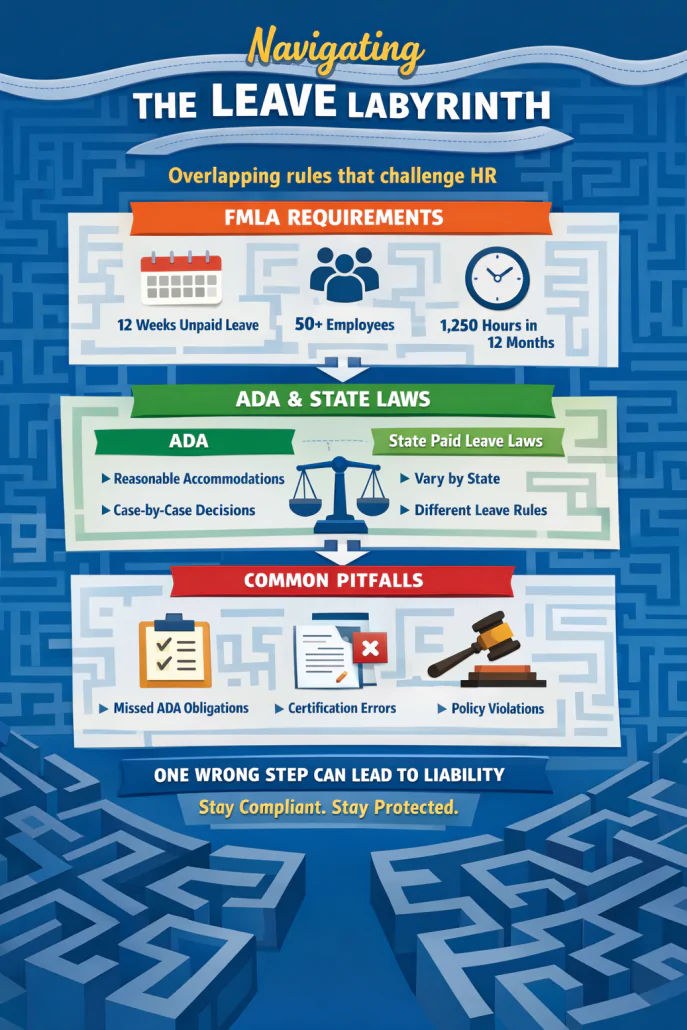
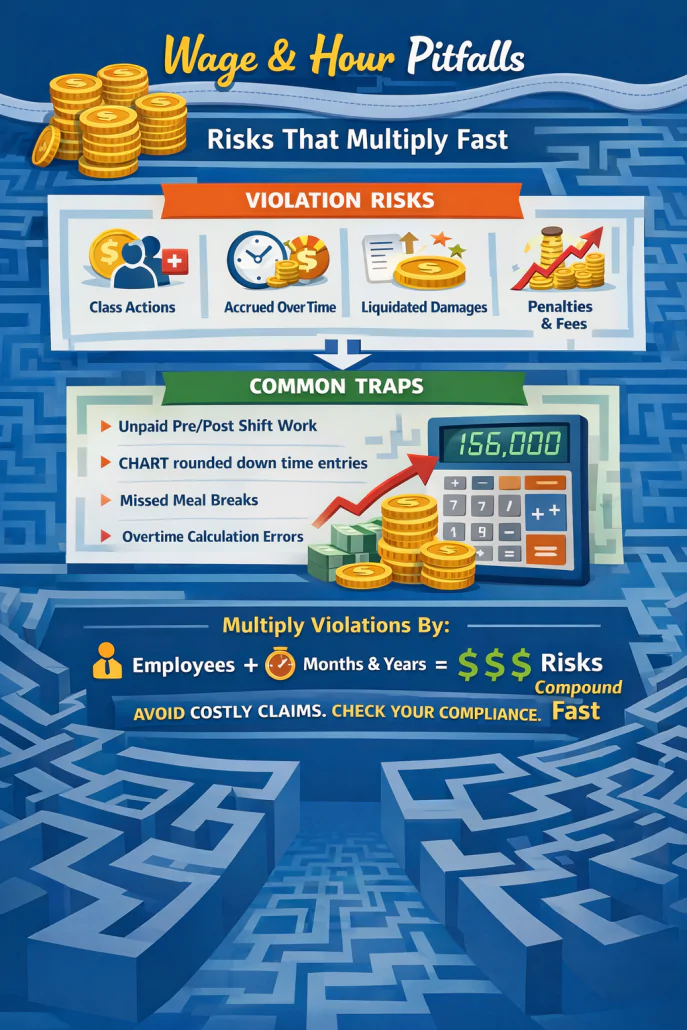
What Wage and Hour Violations Lead to Department of Labor Penalties?
Wage and hour violations are among the most common Department of Labor enforcement actions, particularly involving overtime eligibility, time tracking, and employee classification.
Why Doesn’t Insurance Protect Against Most Employer Liability Claims?
Many business owners discover their insurance gaps only after filing a claim.
General liability insurance covers customer injuries and property damage. It doesn’t cover employment practices claims. You need Employment Practices Liability Insurance (EPLI) for discrimination, harassment, wrongful termination, and wage violations.
But even EPLI has exclusions. Intentional violations aren’t covered. Wage and hour claims often have limited coverage or require specific endorsements. Claims arising from violations of laws like WARN or COBRA may be excluded.
So you get sued for violating the ADA. Your EPLI policy covers the defense costs and potential damages. Good. But the Department of Labor also investigates and finds systematic FMLA violations across your workforce. Those penalties? Not covered.
Or you face a class action wage claim. Your EPLI policy has a sublimit for wage-and-hour claims that’s far below the exposure. You’re on the hook for the difference.
Even when coverage exists, policies contain conditions you might not satisfy. You’re required to report claims promptly. You need to cooperate with the investigation. You can’t settle without insurer consent.
Fail to meet policy conditions, and the insurer denies coverage even for otherwise covered claims.
Insurance is essential, but it’s not a substitute for compliance. And it definitely doesn’t cover regulatory penalties, back taxes, or government-imposed fines.
How Do Employers Reduce Liability With HR Compliance Systems?
The employers who avoid catastrophic liability problems don’t rely on luck or reactive scrambling. They build systematic compliance into operations.
That means regular training so managers understand their obligations. It means documented policies that reflect actual legal requirements, not aspirational statements. It means consistent enforcement mechanisms that create defensible patterns.
It means auditing practices proactively rather than waiting for complaints. Are your exempt classifications correct? Do timekeeping practices capture all compensable time? Does your leave policy comply with all applicable laws?
It means tracking regulatory changes that affect your business. Federal rules shift. States enact new requirements. Court decisions modify how existing laws apply.
Businesses that treat compliance as an ongoing discipline rather than a one-time project significantly reduce their liability exposure. They catch problems before they become claims. They fix issues before they affect multiple employees. They document properly from the beginning.
This doesn’t require a massive internal HR department. Many growing businesses lack the resources to maintain a sophisticated in-house compliance infrastructure. That’s where strategic partnerships change the calculus.
Professional Employer Organizations (PEOs) and HR consulting firms provide structured employment law compliance support that scales with your business. They monitor regulatory changes. They implement compliant policies. They train management. They handle documentation. They provide the infrastructure that small businesses can’t build internally.
When navigating discrimination risks and employment law compliance across multiple jurisdictions, professional support often costs less than a single lawsuit settlement.
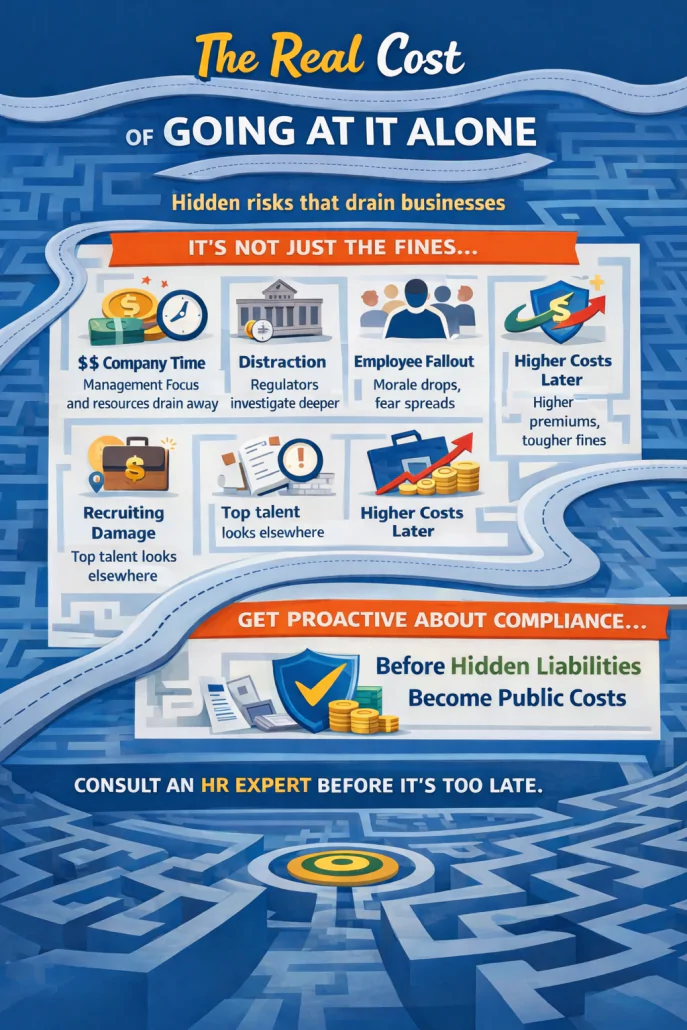
What Is the Real Cost of Going at It Alone?
Key Takeaways:
- Employer liability risks usually start with everyday practices like attendance policies, contractor classification, and documentation, not deliberate violations.
- A single misclassified worker can trigger an audit of your entire workforce, exposing you to back taxes, unemployment insurance, and overtime penalties.
- Inconsistent HR documentation is one of the most common compliance risks. It can make a legitimate termination look like retaliation or discrimination in court.
- General liability insurance and even EPLI have exclusions. Insurance is not a substitute for proactive HR compliance.
- Partnering with a PEO or HR consulting firm gives growing businesses the audits, training, and documentation systems needed to reduce liability exposure.
Ready to reduce employer liability risks and HR compliance exposure before they turn into penalties?? Contact INFINITI HR to learn how our systematic compliance infrastructure protects growing businesses from the liability traps that sink companies operating without professional HR support.
Small gaps don’t stay small when regulators and plaintiffs’ attorneys get involved.
Want more on current employment trends?
Check out the recent blog, The Silent Compliance Gap: FMLA, ADA, and Leave Laws Employers Mishandle Every Day or come back for additional pieces on human resources, payroll, insurance, and benefits.
This article is for informational purposes only and does not constitute tax or legal advice. Consult your CPA or tax advisor for guidance specific to your situation.







Leave a Reply
Want to join the discussion?Feel free to contribute!